
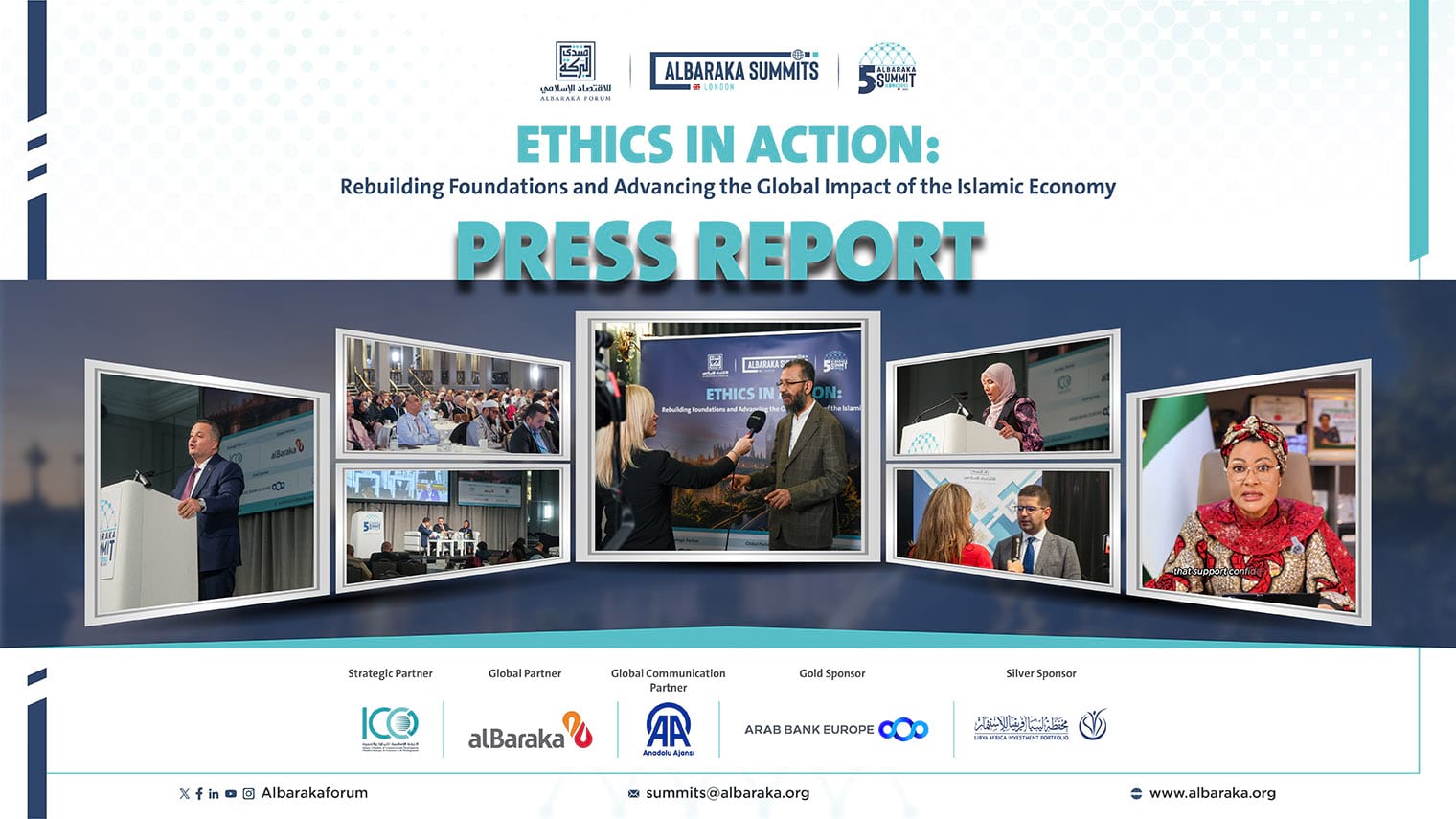
The 5th AlBaraka Summit in London 2026
On 13–14 October 2026, the 5th AlBaraka Summit in London, organised by AlBaraka Forum for Islamic Economy as part of the AlBaraka Summits series, was held at JW Marriott Grosvenor House, London, under the theme “Ethics in Action: Rebuilding Foundations and Advancing the Global Impact of the Islamic Economy.”
Over two days, the Summit brought together government ministers, policymakers, scholars, business leaders, and industry experts for keynote addresses, five thematic panels, and two workshops, exploring ethical leadership, Islamic finance, social development, entrepreneurship, and digital transformation.
The Summit was held with The Islamic Chamber of Commerce and Development (ICCD) as Strategic Partner, Al Baraka Group as Global Partner, and Anadolu Agency as Global Communication Partner, with the support of Arab Bank Europe as Gold Sponsor and Libya Africa Investment Portfolio (LAIP) as Silver Sponsor.
Day 1 – 13 October 2026
As Master of Ceremonies, Ms. Efnan Han, International News Anchor, welcomed distinguished leaders, experts, and visionaries to two days of dialogue on building a more ethical and sustainable global economy. Reflecting on the theme, she emphasised that the strength of an economy lies not only in the wealth it creates, but also in the values that guide it.
The proceedings opened with a recitation from Surah An-Nahl by Shaykh Kazi Ashiqur Rahman, Islamic Scholar, Qur’an Reciter and Teacher. Its emphasis on justice, compassion, integrity, and the fulfilment of commitments set the ethical context for the discussions.
In his welcoming address, H.E. Mr. Yousef Hassan Khalawi, Secretary General, AlBaraka Forum for Islamic Economy, emphasised the responsibility of Islamic financial institutions to translate ethical values into tangible practices, enhance customer experience, and lead positive change across the global financial sector. He stressed that economic progress should be measured not only by the wealth it generates, but also by its contribution to the well-being of society.
He also highlighted the importance of placing ethical responsibility at the heart of economic decision-making, emphasising the role of Islamic economic principles in addressing global challenges and fostering a more equitable and sustainable future.
In his keynote address, H.E. Mufti Muhammad Taqi Usmani, Chairman of the Shari’ah Council, Accounting and Auditing Organization for Islamic Financial Institutions (AAOIFI), and President, Jamia Darul Uloom, Karachi, Pakistan, examined the evolution of modern financial practices and the implications of speculation. He highlighted the importance of connecting financial activity with real trade and productive economic value, considering not only the instruments used but also the economic purposes they serve.
He also explored the social objectives of Islamic economic principles and the need for a more inclusive financial system in which the benefits of economic success are widely shared. Drawing attention to the concentration of financial resources among already wealthy segments of society, he emphasised equitable wealth distribution, broader economic participation, and the contribution of financial development to wider social well-being.
In his keynote address, H.E. Mr. Shakeel Ahmed Yousuf Mohamed, The Honorable Minister of Housing and Lands, Government of Mauritius, outlined efforts to modernise the country’s Waqf framework, strengthen institutional governance, and position Mauritius as a regional hub for Islamic endowments. He highlighted the need to preserve Waqf’s legacy while equipping it to meet the needs of future generations.
He also emphasised effective governance, robust regulatory frameworks, and institutional accountability as foundations for upholding the ethical principles of the Islamic economy and strengthening public trust. His remarks illustrated how institutional reform can translate those principles into sustainable development and lasting social impact.
Drawing on Malaysia’s experience, Ms. Nurul Izzah Anwar Ibrahim, Executive Chairperson of Suluh Centre & Social Activist, highlighted Tabung Haji as a pioneering example of accessible, Shari’ah-compliant savings. Her keynote address emphasised the importance of linking community needs with practical, ethical financial solutions that address real social and economic challenges.
She also explored Islamic endowments as a complementary source of financing, highlighting initiatives to strengthen Waqf institutions and advance sustainable community development.
In recognition of its contribution as Strategic Partner, ICCD was honoured for supporting international cooperation and dialogue around the Islamic economy. Ms. Aalia Jafar, Director of International Relations at ICCD, received the recognition on the Chamber’s behalf.
Al Baraka Group was honoured as Global Partner, recognising its support for international dialogue, collaboration, and the advancement of the Islamic economy. The recognition was received on its behalf by Mr. Malik Temsah, General Manager and Board Member, Albaraka Türk Participation Bank.
Anadolu Agency was recognised as Global Communication Partner for extending the Summit’s reach and bringing its discussions to wider audiences worldwide. Mr. Oğuz Enis Peru, Vice President and Chief Operating Officer at Anadolu Ajansı, received the recognition on the Agency’s behalf.
Arab Bank Europe was honoured for its support as Gold Sponsor and its contribution to dialogue on ethical finance and the future of the Islamic economy. Mr. Haytham Kamhiyah, Chief Executive Officer, Arab Bank Europe, received the recognition on behalf of the bank.
Libya Africa Investment Portfolio was honoured as Silver Sponsor for supporting the Summit and bringing together global perspectives on the development and impact of the Islamic economy. Dr. Akrem Omar Aldeeb, Board Member, Libya Africa Investment Portfolio, received the recognition on its behalf.
H.E. Mufti Muhammad Taqi Usmani was also honoured for his distinguished scholarship and contributions to Islamic economics and finance.
H.E. Mr. Shakeel Ahmed Yousuf Mohamed was recognised for his distinguished participation and contribution to the discussions.
First Thematic Panel
Titled “Strategic Leadership for the Islamic Economy: Policy, Regulation, and Global Direction”, the panel brought together leading figures from the Islamic banking sector to explore the policies and priorities shaping its future. The discussion focused on rebuilding regulatory foundations, integrating ethical principles into public policy, strengthening strategic leadership and global relevance, and identifying priorities for a more resilient, responsible, and impactful Islamic economy.
Moderating the discussion, Mr. Shockat Adam MP, Independent Member of Parliament for Leicester South, House of Commons, UK, emphasised courage, confidence, and collective responsibility in advancing the Islamic economy and guided the exchange on the sector’s strategic priorities.
Mr. Mohammed Ali Addarrat, Chairman, Libyan Foreign Bank, reflected on lessons from financial sector reform, noting that legislation alone is insufficient without strong institutions and the capacity to deliver change. He highlighted investment in human capital, effective regulatory foundations, practical implementation, and meaningful performance indicators to ensure that reforms achieve their intended objectives.
Mr. Zafar Masud, Chairman, Pakistan Banks’ Association; President and Chief Executive Officer, The Bank of Punjab, shared perspectives on Pakistan’s evolving Islamic banking landscape and the need for supportive legal and regulatory frameworks. Connecting that experience with broader developments in global finance, he highlighted the importance of a comprehensive approach to financial and institutional transformation that supports sustainable growth and long-term sector development.
Dr. Hasnita Dato’ Hashim, Chairman and Independent Non-Executive Director of Maybank Investment Bank, discussed robust regulatory frameworks, risk management, and customer protection. She emphasised that effective regulation must go beyond technical compliance, with financial institutions balancing regulatory requirements and financial performance with sustainable outcomes that benefit the economy, communities, and the environment.
Second Thematic Panel
Under the title “Ethics in Action: Rebuilding Market Foundations and Expanding Global Impact across Banking, Investment, and Capital Markets”, the discussion focused on rebuilding ethical confidence in Islamic banking, reinforcing Islamic principles as the foundation of ethical finance, enhancing the sector’s contribution to long-term development, and expanding the global impact of ethical investments and funds.
Mr. Muhammad Nassir Salim, President and Chief Executive Officer, HBL – Habib Bank Limited, discussed transparency, competitive financial products, and customer-focused banking as foundations for trust and genuine customer value. He emphasised the need to preserve the underlying principles of Islamic finance while ensuring that innovation supports real economic transactions, sustainable business growth, and tangible benefits for customers.
Mr. Mohammad Shoaib Memon, Chief Operating Officer, Arab Bank Europe, explored the alignment of Islamic financial principles with regulatory expectations around product design, customer understanding, and financial value. Drawing on the UK regulatory environment, he highlighted how strong governance, clear communication, and responsible practices can strengthen trust, placing customer protection, transparency, and meaningful outcomes at the core of regulation.
Mr. Irshad Mahmood, Islamic Finance Leader; Former Head of Islamic Finance, Partner Deloitte, emphasised that Shari’ah compliance and commercial viability should be considered alongside the broader purpose and impact of capital. He urged a focus beyond financial returns to consider how investments and financial activities contribute to economic outcomes and the well-being of society.
Third Thematic Panel
The panel, titled “Inclusion in the Islamic Economy: Strengthening Social Security through Social Funds and Takaful”, explored how Islamic social finance can advance financial inclusion, strengthen social protection, and foster community resilience. Discussions examined social funds as instruments of collective responsibility, Takaful as a Shari’ah-based insurance model, and the potential of collective financial instruments to support a more inclusive and sustainable Islamic economy.
As moderator, Mr. Abdulla Al Hammadi, Assistant Vice President, Moody’s Ratings, highlighted the gap between Islamic finance’s principles of solidarity and existing financial and social protection systems. Drawing on perspectives from Malaysia, Saudi Arabia, business, and Shari’ah governance, he guided a practical discussion on strengthening social finance structures, addressing governance challenges, and clarifying risk and returns.
Mr. Faraz Khan MBE, Co-Founder & Partner, Sustainadility & Seed Ventures; Special Advisor to ICCD (OIC) Climate Finance, Biodiversity and Carbon Credits & Tokenisation, highlighted the potential of tokenisation to mobilise capital for climate adaptation and resilience. He emphasised capacity-building, technological innovation, and the integration of Shari’ah principles into practical financial solutions to bridge the gap between ethical intentions and meaningful impact.
Ms. Nurul Izza Idris, Director Islamic Finance Department, Bank Negara Malaysia, shared Malaysia’s experience in implementing value-based intermediation, highlighting the alignment of institutional objectives, performance indicators, and stakeholder expectations. She called for a broader understanding of success in Islamic finance, with institutions delivering sustainable returns alongside meaningful economic and social value.
Joining virtually, Mr. Homam Hashem, Chief Executive Officer, Kafalah – Small and Medium Enterprises Loan Guarantee Program, shared Saudi Arabia’s experience in measuring the impact of SME financing and loan guarantees. He highlighted the need to move beyond financial indicators to assess economic growth, job creation, business expansion, and women’s employment, showing how measurable outcomes can strengthen institutional confidence and support informed decision-making.
Mr. Usama Saleh, Chief Shari’ah Audit Executive, TAJBank Ltd., explored how Zakat, Waqf, Sadaqah, and Qard Hasan can work together to strengthen social protection and financial inclusion through mutual assistance, risk-sharing, and support for vulnerable communities. Drawing on Nigeria’s experience, he highlighted the need to bridge Islamic social and commercial finance through effective governance and innovative solutions, including Cash Waqf products.
Fourth Thematic Panel
Titled “From Charity to Development: Activating Waqf, Qard Hasan, Zakat, and Sadaqat for Social Impact”, the panel examined how Islamic social finance can move beyond charitable relief towards sustainable development. Discussions focused on revitalising Waqf, expanding ethical access to finance through Qard Hasan, strengthening Zakat and Sadaqah’s role in community empowerment, and building the institutional capacity needed to scale these instruments and deliver lasting societal impact.
In his institutional presentation, Dr. Tareq Emtairah, Director General, Taawon Welfare Association – Taawon, shared Taawon’s experience in translating Islamic philanthropic values into sustainable development initiatives. He highlighted the role of strong institutions and accountability, and the potential of Cash Waqf, Zakat, and institutional endowments to support vulnerable communities, preserve cultural heritage, and create long-term social impact beyond immediate relief.
Moderating the discussion, Mr. Sagheer Malik, Group Chief Commercial Officer & Managing Director Home Finance, Offa, highlighted the need to align the growth of Islamic finance with meaningful social and economic outcomes. He emphasised integrating, professionalising, and scaling social finance instruments to address poverty, financial exclusion, affordable housing, and access to economic opportunities.
Eng. Wahid Azizi, Trustee and Chief Investment Officer, National Waqf, highlighted the importance of reviving Waqf institutions in the UK to build sustainable economic opportunities. Drawing on the generosity of British Muslim communities, he emphasised Waqf’s potential to move communities beyond short-term charitable dependence towards financial independence, resilience, long-term prosperity, and lasting social impact.
Dr. Hassan Daher, Founder and Chief Executive Officer, Qardus, explored the potential of Qard Hasan to support SMEs with limited access to financing, helping them grow, create jobs, and contribute to wider economic development. He outlined how Qard Hasan, Waqf, and Zakat could work together through innovative financing structures, supported by effective risk management and business advisory services.
Dr. Sohail Hanif, Chief Executive, National Zakat Foundation, explored Zakat as both a personal religious obligation and a collective social responsibility. Drawing on its historical foundations, he emphasised a holistic approach that goes beyond individual charitable giving to strengthen community institutions, promote collective welfare, and empower communities through coordinated action.
Dr. Najib Al Aswad, Chief Executive Officer and Chief Adviser, Islamic Finance Capacity and Advisory Bureau, highlighted the institutional frameworks needed to support Waqf, Zakat, and other Islamic social finance instruments. Drawing on his experience working with governments, he emphasised clear policy objectives, effective regulation, strategic action plans, enabling legislation, and measurable targets to unlock their potential for sustainable development.
Day 2 – 14 October 2026
The second day continued the dialogue on global financial centres, the next-generation Islamic economy, digitalisation, entrepreneurship, social media, the creative economy, applied ethics, and demographic growth. Ms. Efnan Han welcomed participants and introduced the programme.
H.E. Mr. Salim Arda Ermut, Chief Executive Officer and Board Member, Türkiye Wealth Fund, emphasised fairness, responsibility, and transparency as foundations of Islamic finance, highlighting its role in supporting productive economic activities and creating lasting value for society.
He also addressed the role of global financial centres, stressing that international expansion requires more than financial products. Strong institutions, well-developed capital markets, international connectivity, and investor trust are essential to building a credible and sustainable financial ecosystem.
H.E. Dr. Doris Uzoka-Anite, Honourable Minister of State for Budget and Economic Planning – The Federal Republic of Nigeria, highlighted Nigeria’s experience in using Sovereign Sukuk to finance infrastructure, diversify sources of capital, and support national development priorities.
She emphasised that financial success extends beyond capital mobilisation and returns. Sound governance, productive investment, and measurable social impact are essential to translating ethical principles into tangible economic outcomes that create opportunities and improve people’s lives.
H.E. Mr. Yousef Hassan Khalawi honoured H.E. Mr. Salim Arda Ermut in recognition of his contribution, following his keynote address on the role of global financial centres in advancing an ethical Islamic financial environment.
Islamic Scholars’ Pioneers Talk
Moderated by Dr. Najib Al Aswad, the discussion with H.E. Mufti Muhammad Taqi Usmani examined the relationship between Shari’ah compliance and ethical responsibility, including whether everything that is Shari’ah-compliant is necessarily ethical.
Dr. Al Aswad’s questions addressed responsible investment, investment screening, the ethical responsibilities of financial institutions, and the independence of Shari’ah oversight. The exchange also explored practical challenges in keeping Islamic finance accessible and true to its principles, and the need for a shift in mindset across the industry.
Mufti Usmani explained that legal permissibility does not necessarily represent the highest standard of ethical conduct. Certain financial practices may be permissible under Shari’ah while remaining ethically less preferable, underscoring the need to strive for higher standards of integrity and responsibility.
He also emphasised that effective Shari’ah governance requires more than issuing rulings: it depends on their consistent implementation through dedicated oversight, effective internal compliance mechanisms, and strong institutional governance.
Asked about the most pressing change needed in the Islamic finance industry, he replied: “Change of mentality.”
Fifth Thematic Panel
Under the title “The Next-Generation Islamic Economy: Digitalization, Entrepreneurship, Social Media, and Creative Economy”, the panel explored how innovation, emerging technologies, and entrepreneurship can shape the sector’s future. Discussions highlighted ethical entrepreneurship, stronger digital infrastructure, trust, and the empowerment of future generations to deliver sustainable economic and social impact.
Moderating the discussion, Mr. Ibrahim Elsayed, Manager, International Cooperation and Business Development Department, AlBaraka Forum for Islamic Economy, raised questions about the intentions, values, and responsibilities shaping emerging technologies, and how innovation can remain rooted in ethical principles. He emphasised preparing entrepreneurs, developers, and consumers to embrace digital transformation while remaining grounded in Islamic economics.
Mr. Zeiad Idris, Founder & Chief Executive Officer, Algbra, highlighted the importance of building globally competitive businesses and solutions for the world, not just Muslim communities. He called for investment in original technologies and a broader focus beyond Shari’ah compliance, supported by patient capital and stronger digital infrastructure to empower young innovators, support long-term innovation, and enable the Islamic economy to help shape emerging technologies.
Dr. Wael ElDesouki Bedda, Secretary General of Saleh Kamel Sustainable Entrepreneurship & Enterprise Development, emphasised that ethical entrepreneurship extends beyond profitability to integrity in business models, governance, employee relations, financing, and customer engagement. Addressing the challenges facing startups across OIC economies, particularly the shortage of early-stage funding, he called for stronger connections between promising entrepreneurs and investors, and stronger ecosystems for sustainable, impact-driven businesses.
Ms. Yasmine ElMehairy, Guest Lecturer and Entrepreneurship Expert, Said Business School, University of Oxford, examined whether Shari’ah compliance alone is enough, or whether Islamic financial solutions must also compete on quality, innovation, and user experience. She explored changing consumer expectations, demand for specialised and accessible services, and the challenges of building trust, overcoming market fragmentation, and delivering solutions that meet customer needs, while recognising the growing role of financial educators, digital creators, and communities.
Ms. Sidra Iqbal, Senior Broadcast Journalist, highlighted the role of purposeful communication in shaping public perceptions of Islamic finance and connecting with the communities it serves. She emphasised that effective digital engagement must go beyond podcasts and social media content to deliver clear messages that build trust and show how ethical financial solutions can address real needs while promoting inclusion and social justice.
Workshop: Beyond the Label: Applied Ethics Simulation for Islamic Finance Priorities
Dr. Abdulmaten Taroun, Head of Department of Management and Finance, Worcester Business School, University of Worcester, explored how dryland restoration can create jobs, strengthen local livelihoods, and unlock opportunities through carbon markets. Drawing on a proposed national restoration programme in Syria, he examined the financing challenges facing large-scale environmental projects, where substantial upfront costs arise long before revenue is generated. He outlined the potential of combining development funding, carbon finance, and Islamic instruments such as Sukuk to mobilise long-term investment and deliver lasting environmental, social, and economic benefits.
Addressing the ethical dimensions of financial decision-making, Dr. Widad Metadjer, Lecturer in Finance and Business, Worcester Business School, University of Worcester, challenged participants to look beyond financial structures and formal approvals to assess whether investments fulfil their ethical purpose and deliver their intended impact. She led an interactive climate finance simulation in which participants assumed the roles of investors, regulators, Shari’ah boards, issuers, analysts, and community representatives.
Faced with competing priorities, incomplete information, and difficult ethical choices, participants were challenged to reconsider their decisions as new information emerged. The exercise illustrated the gap between formal compliance and real-world outcomes, demonstrating the importance of transparency, sound judgement, stakeholder cooperation, and accountability in responsible finance.
Workshop: Demographic Growth and Islamic Economic Expansion: New Horizons
Led by Dr. Iman Shady, Executive Secretary, Strategic Thinking Center, the workshop explored how demographic shifts and a growing Muslim population are creating opportunities for Islamic finance, halal industries, and investment. She highlighted youth empowerment, entrepreneurship, and workforce development as ways to harness this growth while addressing the economic and social challenges associated with expanding populations.
Drawing on demographic projections and country case studies, she examined how Islamic economic institutions can translate population trends into practical development strategies. Her remarks emphasised data-driven planning, innovative Islamic financial products, and targeted investment in education, healthcare, and infrastructure to support sustainable economic development and shared prosperity.
Closing Remarks
Delivering the closing remarks, Ms. Aalia Jafar reflected on the discussions and the Summit’s growing role in connecting institutions, businesses, and communities.
She highlighted three priorities for advancing the Islamic economy: embedding ethics in institutional governance, strengthening the connection between finance and the real economy, and turning dialogue and shared ideas into meaningful partnerships and tangible outcomes that create lasting economic and social value.