
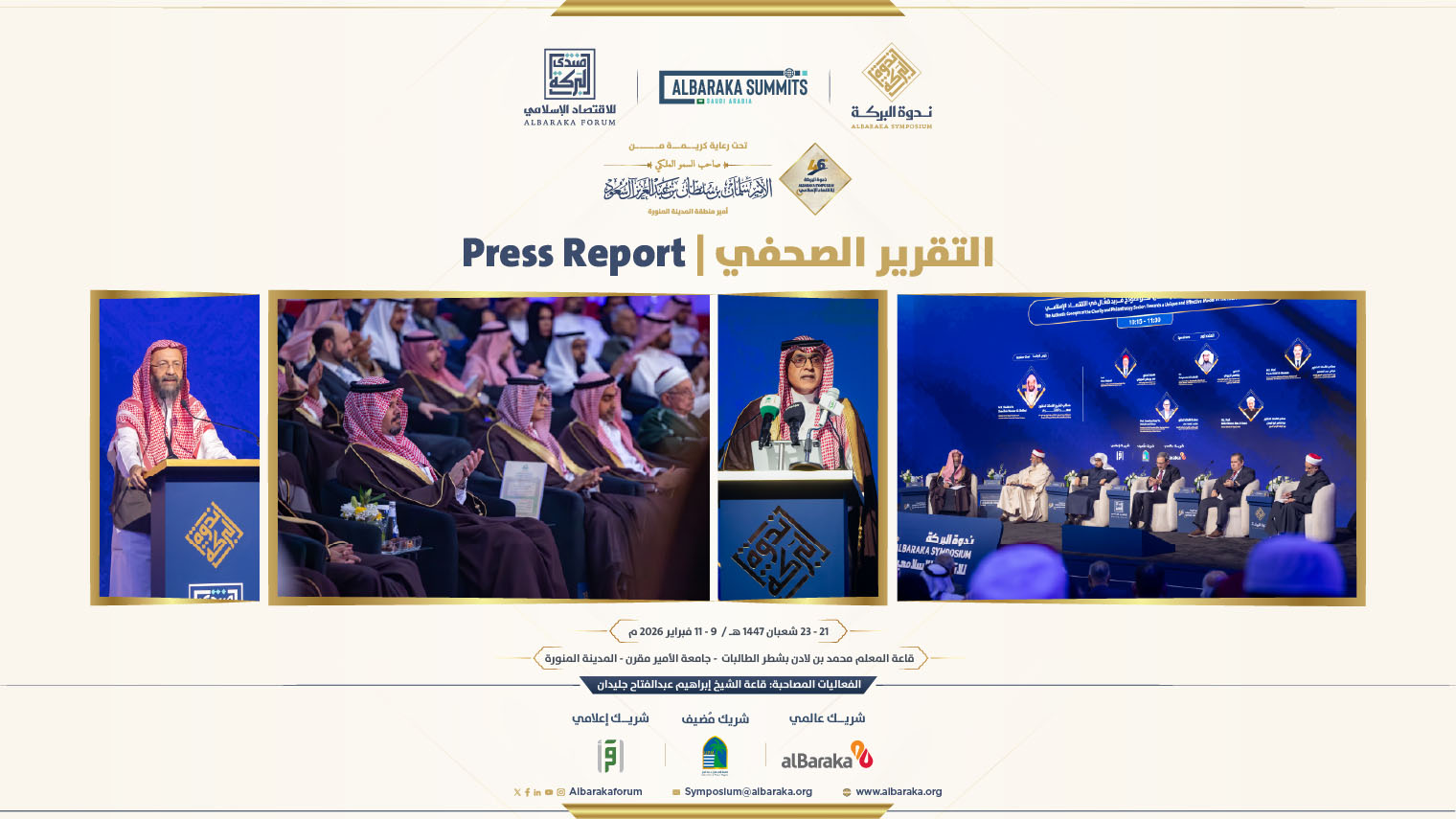
Madinah: His Royal Highness Prince Salman bin Sultan bin Abdulaziz, Prince of the Madinah Region, patronized the opening ceremony of AlBaraka Islamic Economics Symposium (46), “The Righteousness and Benevolence in Islamic Economy: The Future Forward,” organized by AlBaraka Forum for Islamic Economy at Prince Muqrin bin Abdulaziz University in Madinah.
During the ceremony, H.E. Mr. Abdullah Saleh Kamel, Chairman of the Board of Trustees of AlBaraka Forum for Islamic Economy affirmed that the sector of righteousness and benevolence constitutes the largest sector within the Islamic economic system. He stressed that achieving genuine and balanced development cannot be realized without recognizing this sector as a core economic pillar, rather than merely a complementary charitable activity.
In his address, Kamel explained that selecting “The Righteousness and Benevolence in Islamic Economy” as the theme of this year’s symposium reflects a forward-looking vision for the future of Islamic economics. He noted that Madinah, the host city of the symposium, witnessed the earliest foundations of Islamic economic practice, where the concepts of waqf (endowment), spending, and benevolence were established as enduring economic and developmental values throughout history.
He further highlighted that over past decades, AlBaraka Symposium has played a pivotal role in developing modern Islamic economic instruments, most notably Islamic banking. He emphasized that the coming phase requires advancing integrated pathways that include the economy of righteousness and benevolence, activating the role of capital, and upholding ethics and values as the fundamental foundation of the Islamic economy.
Kamel added that these three pathways collectively form the basis for shaping the future of Islamic economics, alongside the continued development of key instruments that have emerged over the past fifty years—such as sukuk and takaful insurance—as well as the optimal use of modern financial technologies to enhance impact and sustainability.
He also underscored the importance of empowering the non-profit sector, noting that the Saudi experience in this field represents an inspiring national model with strong potential for global replication, contributing to sustainable development and maximizing social impact.
Following this, His Excellency Sheikh Hisham bin Mahmoud, Grand Mufti of the Republic of Tunisia, delivered a speech in which he affirmed that holding the symposium in the city of the Prophet Muhammad (peace be upon him) embodies the values of righteousness, benevolence, and social solidarity upon which the Islamic message was founded. He cited the historical model of cooperation between the Muhajirun and the Ansar, emphasizing that these values form the cornerstone of humanitarian and economic action in Islam.
He praised the Kingdom of Saudi Arabia’s pioneering role—under the leadership of the Custodian of the Two Holy Mosques and His Royal Highness the Crown Prince (may God protect them)—in supporting charitable and developmental initiatives and in promoting the principles of compassion and solidarity. He also commended the experience of AlBaraka Group and AlBaraka Bank in Tunisia as an integrated model that combines banking practice with jurisprudential vision, grounded in the principle of social solidarity and support for those in need. He further highlighted the contributions of the late Sheikh Saleh Abdullah Kamel, may God have mercy on him, to developmental work, and the continuation of this approach by his family and successors, expressing his appreciation for the patronage of His Royal Highness the Prince of the Madinah Region.
The ceremony also featured a video produced by AlBaraka Form, titled “The Economy of Righteousness and Benevolence: Giving That Creates Lasting Impact”, which traced the historical roots of the economy of giving in Islam—from the first waqf established in Madinah to the transformation of the non-profit sector into a significant economic and developmental driver in the modern era. The presentation highlighted the Kingdom’s experience in empowering the non-profit sector within the framework of Saudi Vision 2030, reflecting its evolution into an effective developmental force supporting economic and social sustainability.
In the same context, His Royal Highness the Prince of the Madinah Region oversaw the signing of three Memoranda of Understanding. The first was signed between the AlBaraka Forum for Islamic Economy and the Islamic University of Madinah, aimed at strengthening institutional integration and enhancing programs and activities that support human development.
The second memorandum was signed between the AlBaraka Forum for Islamic Economy and INCEIF University, to support scientific research and encourage the exchange of knowledge and expertise. The third was signed with King Abdulaziz University, represented by the Institute of Islamic Economics, to enhance research and knowledge integration and to develop academic resources.
Launch of the 46th AlBaraka Symposium Sessions in Al-Madinah Al-Munawara with the Participation of Experts from 18 Countries
The first day of the 46th AlBaraka Islamic Economics Symposium commenced on Monday 9 February 2026 / 21 Sha’ban 1447 AH under the theme: “The Righteousness and Benevolence in Islamic Economy: The Future Forward”, held at the Hall of Master Muhammad Awad bin Laden, University of Prince Mugrin, Madinah – Kingdom of Saudi Arabia.
The symposium brings together distinguished excellencies, leading financial thinkers, scholars, policymakers, and representatives of financial and development institutions from 18 countries, in one of the region’s largest intellectual and economic gatherings.
In his welcome address, H.E. Mr. Yousef Hasan Khalawi, Secretary General, AlBaraka Forum for Islamic Economy, emphasized the qualitative significance of this year’s theme. He noted that focusing on the economic dimension does not overlook the Shari’ah, legal, social, and charitable aspects associated with the righteousness and benevolence sector. He stressed the foundational role Islamic banks have played in shaping modern Islamic economics and highlighted that examining the nature and limits of this role constitutes a key objective of the symposium’s scholarly discussions.
For his part, H.E. Mufti Muhammad Taqi Usmani, Chairman of the Shari’ah Council, Accounting and Auditing Organization for Islamic Financial Institutions (AAOIFI), President, Jamia Darul Uloom, Karachi, Pakistan, underscored the importance of directing attention to the righteousness and benevolence sector as one of the most complete manifestations of Islamic economics. He also noted that AlBaraka Symposium have played a pivotal role in advancing the Islamic finance industry and crystallizing key issues within Islamic economic thought.
Session One: “The Authentic Concepts of the Charity and Philanthropy Sector: Towards a Unique and Effective Model in the Islamic Economy”
The first session, titled “The Authentic Concepts of the Charity and Philanthropy Sector: Towards a Unique and Effective Model in the Islamic Economy,” brought together prominent experts in economics and Islamic jurisprudence to discuss the intellectual and Shari’ah foundations of righteousness and benevolence in achieving sustainable economic development.
The session was moderated by H.E. Sheikh Dr. Saad bin Nasser Al-Shithri, Advisor to the Royal Saudi Court, member of the Council of Senior Scholars. He emphasized that righteousness and benevolence constitute a fundamental pillar of Islamic economics rather than a secondary matter, given their role in expanding economic participation and addressing poverty by transforming beneficiaries into productive contributors and entrepreneurs. He further stressed the importance of specialized academic research in this field and the need to integrate Shari’ah foundations with measurable social and economic impact.
Prof. Moez Mejouli, Professor of Fiqh and Usul Al‑Fiqh and Head of the Department, Ez-Zitouna University, Tunisia, presented a paper titled: “The Authenticity of the Charity and Philanthropy Sector in the Islamic Economy: Its Components and Motivations.” He affirmed that righteousness and benevolence are textually established in the Qur’an and Sunnah and are intrinsically linked to the objectives of stewardship and civilization-building. He called for repositioning the sector within an integrated Islamic economic model through rebuilding functional awareness, adopting Maqasid-based analysis, transforming resources into productive empowerment tools, and strengthening governance and institutional efficiency.
Dr. Belqasem Al-Zubaidi, Associate Professor, Department of Shari’ah and Islamic Studies, College of Arts and Human Sciences, King Abdulaziz University, addressed: “The Concept of Ihsan (Benevolence and Excellence) as a Driver of Generosity and Its Economic and Utilitarian Patterns.”
He explained Ihsan as an integrated legislative system and a catalyst for giving, outlining its various forms—Zakat as an obligatory benevolence ensuring sufficiency, voluntary charity bridging needs gaps, Qard Hasan as empowerment financing to address liquidity shortages, and other non-financial forms of beneficial benevolence.
H.E. Prof. Fayad Abd Al-Monem, Former Egyptian Minister of Finance, Professor of Economics, The Faculty of Commerce, Al-Azhar University, discussed the economic analysis of the sector’s components according to Islamic economic concepts. He emphasized that Islamic economic assumptions are realistic in understanding human nature, noting that benevolence behavior supports economic growth and that the concept of barakah represents genuine growth beyond mere numerical increase. He suggested that the righteousness and benevolence sector could ideally constitute nearly one-third of overall economic activity.
Prof. Emeritus Dato’ Dr. Mohd Azmi Omar, President and Chief Executive Officer, The International Centre for Education in Islamic Finance (INCEIF), The Global University of Islamic Finance, examined the non-profit sector in conventional economics and highlighted opportunities for convergence with Islamic social finance models through professionalism, impact measurement, and productive activation of zakat and waqf.
The session concluded with remarks by H.E. Prof. Abdul Nasser Abu Al-Basal, Former Minister of Awqaf, Jordan, who emphasized the independence and distinctiveness of the righteousness and benevolence sector as an original component of Islamic economics since the Prophetic era, underscoring the importance of maintaining its institutional autonomy.
Session Two: “The Role of Islamic Banks in Building and Developing the Charity and Philanthropy Sector”
The second session, titled: “The Role of Islamic Banks in Building and Developing the Charity and Philanthropy Sector”, convened experts from multiple countries to explore the institutional and strategic roles of Islamic banks in strengthening benevolence and philanthropy.
During the second session, titled “The Role of Islamic Banks in Building and Developing the Charity and Philanthropy Sector,” held as part of the AlBaraka Islamic Economics Symposium, H.E. Mohamed El-Mamoun El-Kacimi El-Hassani, Minister of State, Dean of Djamaa El Djazair, expressed his appreciation for the scholars who have enriched the AlBaraka Symposia with valuable academic research and scholarly fatwas that have become important references for Islamic financial institutions in general.
He also paid special tribute to the founder of the symposium, the late Saleh Abdullah Kamel, acknowledging his pioneering role and foundational contributions, alongside a distinguished group of early leaders who laid the groundwork for Islamic finance and accompanied its development and progress over the years.
H.E. Dr. Fahad AlElayan, Senior Vice President and Head of Shari’ah Group, Sustainability and Social Responsibility, Bank Al Jazira, presented on Islamic banks and charity instruments, highlighting social responsibility as an ethical commitment and reviewing the bank’s allocation of SAR 100 million and 1% of net profits to sustainability and social responsibility programs.
Mr. Tariq Ismail Yousuf, Director of Shariah Supervision, Arab Islamic Bank, discussed the strategic investment role of Islamic banks in philanthropy, calling for a shift from donation channels to strategic partnership models, including innovative tools such as waqf investment funds and social impact sukuk.
H.E. Datuk Mohd Irwan Mohd Mubarak, Chairman, Bank Kerjasama Rakyat Malaysia Berhad, addressed governance and structuring in Islamic banks, stressing the integration of Maqasid Al-Shari’ah into decision-making and product structuring, with a focus on measurable development impact and enhanced transparency.
Dr. Abdulrahman Badr AlQassar, Assistant Professor, Kuwait Technical College; Member of the Chartered Governance Institute UK & Ireland (CGIUKI), delivered an applied governance perspective on the role of Islamic banks in supporting and developing the sector of righteousness and benevolence. He emphasized that the real challenge does not lie in a lack of resources, but rather in a governance gap between Shariah-based values and the operational models of banking institutions. He explained that Islamic economics is fundamentally built upon an ethical and value-driven framework, and that the concepts of Environmental, Social, and Governance (ESG) are merely a modern reformulation of deeply rooted Islamic principles.
Session Three: “The Charity and Philanthropy Sector and Investment Channels: Charitable Investment within the Framework of Shari’ah Compliance”
The third session, titled: “The Charity and Philanthropy Sector and Investment Channels: Charitable Investment within the Framework of Shari’ah Compliance”, was moderated by Prof. Al-Bara’a Abu Laban, Dean of the Institute of Islamic Economics, King Abdulaziz University, the session emphasized directing charitable resources toward prudent investment pathways that ensure sustainable development impact while adhering to Shari’ah principles.
Prof. Abdullah Al Kilani, Professor of Fiqh and Usul Al‑Fiqh, University of Jordan, discussed Shari’ah-compliant investment strategies for waqf funds, advocating a shift toward modern governance-driven models.
Dr. Mohammed ElShobake, Head of Shari’ah Department, International Islamic University Malaysia, examined regulatory frameworks for investing zakat funds in the modern era, highlighting their economic and social functions beyond immediate worship, and noting that exceptional investment of zakat funds may be permissible under defined Shari’ah conditions to achieve greater benefit.
Assoc. Prof. Sutan Emir Hidayat, Director, Islamic Economy Infrastructure Ecosystem – Indonesia, presented Indonesia’s experience in managing Hajj savings funds within the framework of Indonesia’s “Golden 2045” vision, emphasizing governance, transparency, and diversified investment portfolios to maximize economic impact.
The first day’s sessions concluded with strong emphasis on institutional governance, strategic investment, and the integration of Shari’ah objectives with sustainable economic development—reinforcing the symposium’s overarching vision of shaping a forward-looking model for righteousness and benevolence within Islamic economics.
Second Day Sessions of the 46th AlBaraka Islamic Economics Symposium Continue
Tuesday 10 February 2026 / 22 Sha’ban 1447 AH marked the continuation of the second day sessions of the AlBaraka Islamic Economics Symposium, held under the theme: “The Righteousness and Benevolence in Islamic Economy: The Future Forward”, held at the Hall of Master Muhammad Awad bin Laden, University of Prince Mugrin, Madinah – Kingdom of Saudi Arabia.
The second day witnessed the participation of a distinguished group of experts and specialists in the fields of economics, finance, and charitable work, continuing the in-depth academic and professional discussions aimed at advancing the righteousness and benevolence sector within the broader framework of Islamic economics.
Keynote
In his keynote address, Dr. Abdul Bari Khan, President, Indus Hospital and Health Network – Pakistan, highlighted the promising potential of Awqaf in the healthcare sector, describing them as a dynamic economic model that transforms wealth into sustainable public benefit. Drawing on the case study of Indus Hospitals, he explained that strengthening the Waqf ecosystem through innovation and scientific research elevates healthcare from a moral obligation to a strategic pillar for national resilience and dignity.
Session four: “The Future of the Philanthropy and Benevolence Sector in Light of Innovation and Development: Opportunities and Challenges”
The session was chaired by Dr. Tarik Akin, Head of The Department of Finance, Investment and Finance Office of the Presidency of the Republic of Turkey. He emphasized the importance of innovation and development in shaping the future of Islamic social finance and underscored the need to analyze both opportunities and challenges facing the righteousness and benevolence sector through practical models and experiences to enhance its impact and sustainability.
Mr. Dima Djani, Group Chief Executive Officer at Hijra – Indonesia, stressed the importance of developing innovative Waqf instruments that enable younger generations to participate more easily, particularly in light of the difficulty of owning large assets dedicated to Waqf. He explained that the “cash waqf linked to deposits” initiative seeks to integrate the concept of Waqf into everyday banking transactions and promote awareness of it as a sustainable investment tool. He also presented the outcomes of three pilot projects focused on employment generation, access to clean water, and food security. Despite challenges such as limited financial literacy and varying levels of trust, he affirmed that technology and financial inclusion are key to expanding the future impact of Waqf.
Mr. Rafe Haneef, Chief Executive Officer, MBSB Bank Berhad, highlighted the importance of embedding Ihsan in charitable work. He noted that Ihsan is not merely about giving, but about sincerity, excellence, and creating sustainable impact that transforms beneficiaries into active contributors to development. He called for macro-level impact measurement, including tracking the non-profit sector’s contribution to GDP, citing experiences from advanced economies and Saudi Arabia. He further emphasized adopting a clear framework to measure inputs, outputs, outcomes, and impact to ensure that Zakat and charitable work contribute effectively to economic empowerment and improved quality of life.
Assoc. Prof. Dr. Ziyaad Mahomed, Associate Professor and Head of Online Programs, The Global University of Islamic Finance, discussed the role of crowdfunding in mobilizing capital for charitable work and industry development. He explained that crowdfunding has evolved from disintermediation to smartphone integration, and now toward building trust through tracking and transparency. Referencing historical examples from early Islamic tradition, he highlighted the power of collective mobilization while cautioning against what he described as “viral contagion” that may divert donations from genuine priorities. He stressed the importance of diversifying funding sources, reducing donor fatigue, and gradually transitioning from pure donations to productive financing, citing Saudi Arabia’s national platforms and their ability to facilitate rapid giving and maximize impact.
Dr. Fahad AlMousa, Senior Shari’ah Advisor, Kuwait Finance House, commended the Kingdom of Saudi Arabia for hosting and organizing the symposium. He commented on research addressing the utilization of Zakat, cash Waqf, and crowdfunding to support the real economy and empower middle- and low-income groups, emphasizing that Zakat is not merely an individual act of worship but a developmental instrument with economic and social impact.
Dr. Khaled Khalifa, Senior Advisor to the UN High Commissioner for Refugees (UNHCR) on Islamic Finance, and UNHCR Representative to the Gulf Cooperation Council (GCC) Countries, addressed innovation in cash Waqf and crowdfunding and their role in enhancing transparency and building trust through digital tools. He emphasized preserving the authenticity of Zakat as an integrated developmental system and called for strengthening the independence of charitable organizations and expanding their global scope.
Session five: “Unique Models of Islamic Giving: Between the Authenticity of Concepts and the Modernity of Methods and Institutional Roles”
The fifth session, titled: “Unique Models of Islamic Giving: Between the Authenticity of Concepts and the Modernity of Methods and Institutional Roles”, was moderated by Dr. Abdul Hamid Assyaq, Director, Dar Al-Hadith Al-Hassania, Al-Qarawiyyin University, Ministry of Endowments and Islamic Affairs, Morocco, the session explored various models of giving in Islamic economics. He presented a classification of giving instruments according to their Maqasid dimensions, including:
- Immediate relief tools such as Zakat and charity to address urgent needs and preserve dignity;
- Empowerment tools such as grants to enable economic independence;
- Institutional sustainability tools, foremost among them Waqf;
- Temporary support tools such as stipends.
He emphasized that this classification aims to build precise poverty alleviation maps, link Zakat with empowerment programs, and allocate Awqaf to strategic sectors.
Prof. Essam Abu Al-Nasr, Professor of Accounting and Auditing, Faculty of Commerce, Al-Azhar University, presented a paper titled: “Zakat: From Individual Practice to Institutional Giving in Light of Islamic Economics and Its Objectives.”
He examined the mechanisms and importance of transitioning from individual voluntary Zakat practices to structured institutional frameworks supported by governance, automation, and digitalization. Among the key findings were that institutional Zakat enhances social development and economic benefits, while challenges include confusion between obligatory Zakat and voluntary charity, limited trust in institutional work, and pressure on Islamic charitable institutions. He concluded by emphasizing the necessity of coordination and integration among Zakat institutions.
Mr. Zeinoul Abedien Cajee, Founder and Chief Executive Officer, the National Awqaf Foundation of South Africa, described Waqf as one of the most powerful sustainable strategic tools for empowering communities and combating poverty. He highlighted the importance of Waqf assets in generating recurring social and economic returns supporting education, healthcare, and community infrastructure. He reviewed South Africa’s experience in developing institutional Awqaf such as commercial complexes around mosques and educational and charitable institutions that provide sustainable income. He noted that the Foundation operates within a robust legal and governance framework ensuring sustainability and transparency, and is entering a new phase of expansion.
Dr. Abdulaziz AlDemaigi, Head of Shari’ah Advisory and Research Department, Saudi National Bank, discussed the strategic position of charity (Sadaqah) within Islamic finance instruments and the essential differences between Sadaqah and Hibah (gifts). He explained that Sadaqah is tied to specific Shari’ah objectives and designated beneficiaries and cannot be revoked once given, whereas Hibah is broader in scope. He also emphasized the role of crowdfunding platforms in enhancing reliability, transparency, and privacy, describing charity as an effective institutional act that strengthens social solidarity and humanitarian values.
Dr. Abdullah Owaid AlRashedi, Associate Professor, Department of Comparative Fiqh and Legal Policy, College of Shari’ah and Islamic Studies, Kuwait University, elaborated on Qard Hasan (benevolent loans), its Shari’ah ruling, the regulations governing service charges, and ways to develop it through Islamic banks, Qard Hasan investment funds, cash Waqf for lending, microfinance banks, and crowdfunding platforms. He highlighted its role in financial inclusion, women and youth empowerment, and support for indebted individuals. He emphasized the need to manage Qard Hasan according to strict Shari’ah principles that prevent any transformation into interest-based benefit, in line with the principle of “no harm and no reciprocating harm.”
H.E. Dr. Lahoucine Ait Said, Professor of Higher Education, Cadi Ayyad University, Morocco, affirmed that Zakat is a collective act of worship and a fundamental social institution that should not be reduced to unorganized individual practice. He stressed that the state is best positioned, both legally and practically, to collect and distribute Zakat efficiently and justly, citing historical practice during the era of the Rightly Guided Caliphs and contemporary models where Zakat is structured within state systems.
H.E. Dr. Ahmed Abdulaziz Al-Haddad, Grand Mufti and Director of the Fatwa Department, Islamic Affairs and Charitable Activities Department, Dubai, emphasized that the culture of charity and solidarity has been deeply rooted in Islam since the Prophetic era, inspired by the model of Madinah built on altruism and resource sharing. He described charity as a civilizational value that builds individuals and societies and fulfills the objectives of Shari’ah in justice and reform, calling for institutionalized and organized giving as a pillar of social and economic stability.
Session Six, a panel discussion: “The Current Realities and Future Prospects of Inclusive Non-Profit Institutions: A Forward-Looking Perspective”
The sixth session, a panel discussion titled: “The Current Realities and Future Prospects of Inclusive Non-Profit Institutions: A Forward-Looking Perspective” was moderated by H.E. Dr. Hamed Merah, CEO, Saudi Center for Commercial Arbitration, the panel addressed the prospects of Islamic economics and its role in empowering the non-profit sector, as well as the contributions of Islamic banks and financial institutions and future outlooks for the sector.
H.E. Mr. Yousef Hasan Khalawi, Secretary-General, AlBaraka Forum for Islamic Economy, emphasized that the Forum goes beyond research to policy formulation and long-term future foresight. He explained that the Forum’s long-term project involves defining the components of Islamic economics and that think tanks focus on sustained outputs rather than annual deliverables. He also stressed that Islamic banks are not limited to charitable disbursement but are central civilizational institutions capable of instilling trust in emerging entities through expertise and institutional planning.
H.E. Mr. Jameel Ahmad, Governor, State Bank of Pakistan, underscored the importance of integrating the non-profit and charitable sector into the formal economic system due to its growing scale and impact. He emphasized the need for clear regulatory frameworks to preserve public trust, build institutional capacity, incentivize registration and compliance, and connect charitable organizations with financial service providers to enhance resource management and support SMEs for sustainable economic and social impact.
Datuk Dr. Mohd Ghazali Md. Noor, Secretary General, The World Zakat and Waqf Forum, noted that the world is witnessing profound shifts in prevailing values and economic models, necessitating a return to the ethical and human foundations established by Islam more than fourteen centuries ago. He described Zakat and Waqf as sustainable civilizational tools capable of achieving justice, preserving dignity, and promoting social peace in a world challenged by conflict, sanctions, and imbalance. He called for moving beyond narrow transactional approaches toward a comprehensive, value-based and collaborative development model that is more just and sustainable for humanity.
46th AlBaraka Symposium Concludes and Announces “Human Capital in Islamic Banking” as Theme of Next Edition
The AlBaraka Islamic Economics Symposium (46) has concluded its proceedings after holding six specialized academic sessions under the theme: “Righteousness and Benevolence in the Islamic Economy: Toward a New Future,” with the participation of an elite group of scholars, experts, and practitioners from various countries.
H.E. Mr. Yousef Hasan Khalawi, Secretary-General, AlBaraka Forum for Islamic Economy, affirmed in his closing remarks that the symposium embodied a solid academic platform for dialogue, reflection, and anticipation of the horizons of the coming phase. He noted that the rich discussions revealed broad opportunities for renewed scholarly effort, research, and innovation in the path of Islamic economics, in light of accelerating global economic transformations.
He explained that the “economy of righteousness and benevolence” is emerging as a strong candidate for the next stage of Islamic economic development. While Islamic banking has undoubtedly been the most prominent pillar over the past fifty years, contributing significantly to its institutional global presence, the coming phase may witness the rise of righteousness and benevolence as a broader framework for enhancing developmental and social impact, while Islamic banking continues to play its pivotal role as the largest entity in terms of assets, expansion, and acceptance.
H.E. Mr. Yousef Hasan Khalawi announced that the upcoming 47th edition of the symposium will be dedicated to Islamic banking under the theme: “Human Capital in Islamic Banking.” The discussions will address key issues, including the role of Shari’ah boards, qualification and succession development, leadership building in Islamic banking institutions, and the formulation of an ethical charter for employees in Islamic financial institutions—enhancing sound governance and reinforcing professional values derived from Islamic Shari’ah.
The Secretary-General praised the scholarly efforts presented by researchers and commentators, emphasizing that this year’s theme opened new research horizons for universities and research centers, strengthened integration between theory and practice, and supported the development of a new generation of researchers specializing in righteousness and benevolence and their institutional tools.
On the sidelines of the symposium, a series of scientific lectures and workshops were held, discussing the main themes of the edition and witnessing notable attendance and interaction.
Prof. Dr. Elias Dardour, Head of Shari’ah and Law Department, Ez-Zitouna University, Tunisia, delivered a public lecture entitled: “Financial Engineering for Awqaf: Waqf Sukuk and Waqf Funds – Their Structures, Mechanisms, and Returns.” He reviewed the technical and Shari’ah frameworks of these tools as a contemporary gateway to developing waqf activities and enhancing their sustainability. He explained that waqf sukuk and waqf funds are modern instruments capable of maximizing returns while preserving the original endowment and adhering to Shari’ah guidelines, in addition to expanding community participation and transforming waqf into an effective developmental tool that supports charitable projects and achieves sustainable economic and social impact.
Within the “Pioneers’ Legacy Track,” Prof. Beshr Moafaq, International Expert and General Supervisor, Encyclopedia of Islamic Economics and Finance, moderated a dialogue with H.E. Mufti Muhammad Taqi Usmani, Chairman of the Shari’ah Council, Accounting and Auditing Organization for Islamic Financial Institutions (AAOIFI), President, Jamia Darul Uloom, Karachi, Pakistan, in a session entitled: “My Memories with Islamic Banking.” Mufti Usmani reflected on his academic beginnings and scholarly journey, stressing the importance of combining Shari’ah foundations with real-world requirements, and highlighting the role of scholars in developing the Islamic banking industry through research, authorship, and structuring Shari’ah-compliant contracts and products.
Dr. Eman Shady, Executive Secretary, Strategic Thinking Center, presented a workshop entitled: “Demographic Growth and Islamic Economic Expansion: New Horizons.” She discussed the impact of global Muslim population growth in strengthening the young workforce and increasing demand for Shari’ah-compliant products, emphasizing the importance of data-driven planning to confront challenges related to education, employment, and healthcare, and to invest in demographic opportunities in rapidly growing Islamic markets.
On the third day, a workshop entitled: “Mechanisms for Utilizing Awqaf to Support Charitable and Social Projects,” was presented by Dr. Abdullah Al-Ghamdi, Waqf Sector Expert. The workshop highlighted the Shari’ah concept of waqf and models of its utilization in supporting charitable, educational, health, and community development initiatives. It also emphasized the role of waqf in strengthening sustainable development pathways.
The symposium also featured a workshop entitled: “The Evolution of Civil Society Organizations Worldwide: Their Activities and Impact,” delivered by Dr. Ali Abul Ezz, Head of Shari’ah Internal Audit Department, Jordan Islamic Bank, in cooperation with Dr. Abdulnasser Hamdan, Director of the Maqasid Project, AlBaraka Forum for Islamic Economy.
The workshop explored applied frameworks for maqasid-based governance and mechanisms for transforming Shari’ah objectives into institutional tools that enhance social impact and sustainability.
The discussions addressed key themes including maqasid guidelines, institutional strategies, practical applications of zakat, waqf, and qard hasan, regulatory challenges and solutions, as well as contemporary models supporting the transformation of the sector into a sustainable developmental driver.
Dr. Hesham Zaki, Executive Secretary, Saleh Kamel Award for Islamic Economics, chaired the interactive academic session held under the auspices of the Saleh Kamel Islamic Economics Award, entitled: “From Research to Impact.” The initiative aimed to connect academic research with practical implementation and provide a platform for postgraduate students to present their innovative research projects before a distinguished group of scholars and experts.
Scholarly commentary was provided by H.E. Prof. Fayad Abd Al-Monem, Former Egyptian Minister of Finance and Professor of Economics, The Faculty of Commerce, Al-Azhar University, and Chairman of the Scientific Committee of Saleh Kamel Islamic Economics Award, who affirmed that the prize represents a global academic project seeking a qualitative leap in the field of Islamic economics.
In the workshop entitled “Empowering Young Minds: Entrepreneurship as a Pathway to Change and Creativity,” Dr. Wael ElDesouki, Secretary General of Saleh Kamel Sustainable Entrepreneurship & Enterprise Development, presented an inspiring vision of entrepreneurship through the lens of righteousness and benevolence. He emphasized that business success should be measured by social impact alongside profits, highlighting the importance of ethics, transparency, responsibility, and human dignity at the heart of economic development.