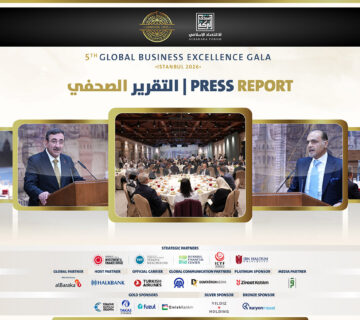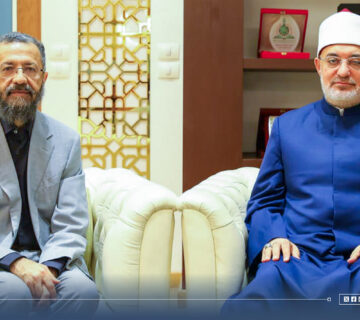

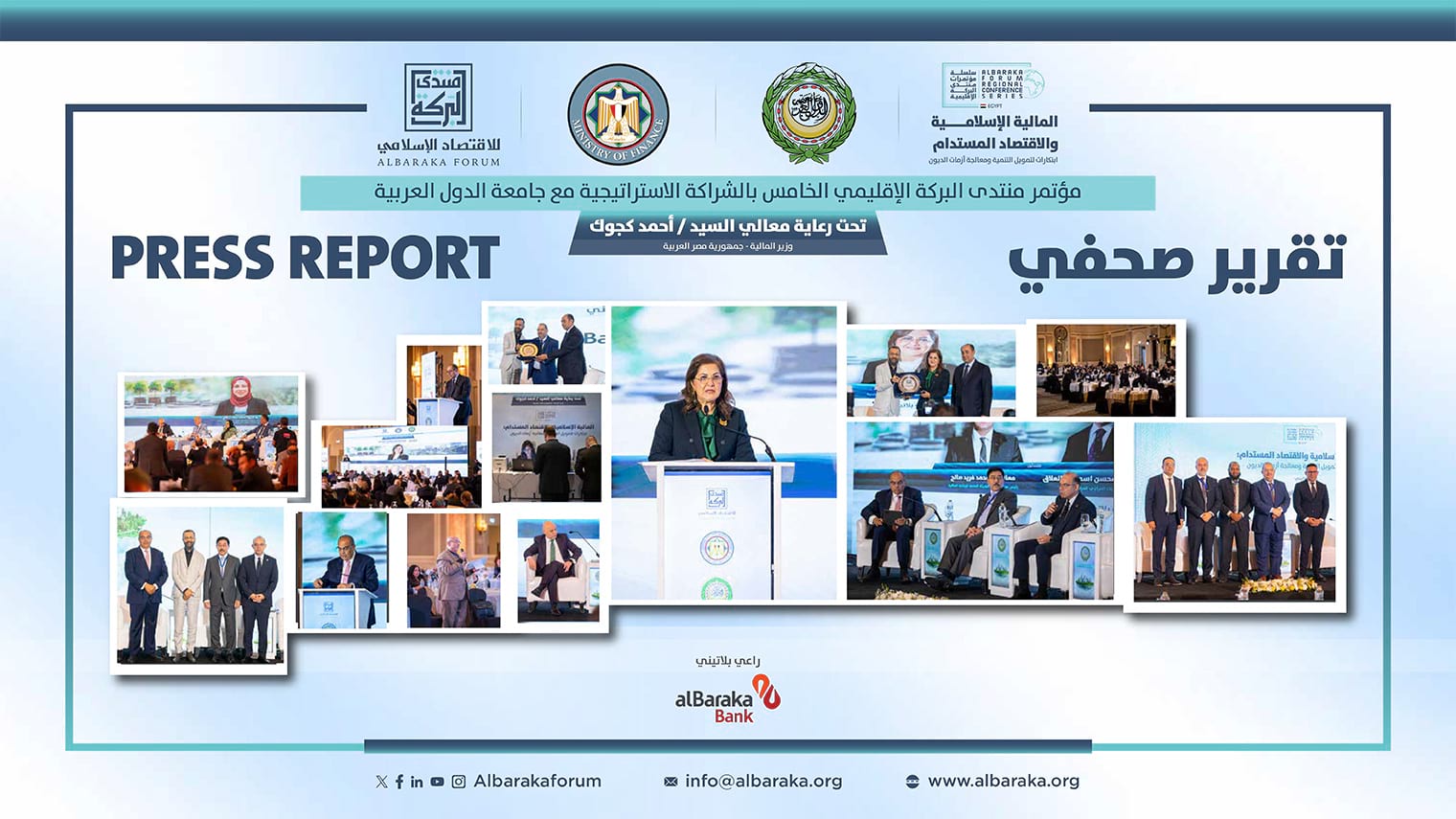
The Fifth AlBaraka Forum Regional Conference commenced in Cairo on Tuesday, 16 December 2025, under the title: “Islamic Finance and Sustainable Economy: Innovations in Development Financing and Debt Solutions”, held in strategic partnership with the League of Arab States and under the patronage of H.E. Mr. Ahmed Kojok, Minister of Finance of the Arab Republic of Egypt, at the Four Seasons Hotel – Nile Plaza.
Opening Ceremony
During his opening address, Mr. Yousef Hassan Khalawi, Secretary General of AlBaraka Forum for Islamic Economy, emphasized that what the world is witnessing today is not merely a transient financial crisis, but a clear imbalance in the global economic scale that has reached a level difficult to reform from within the current system, stressing that establishing economic justice requires a fundamental change in this system, rather than reliance on superficial reforms that have proven ineffective.
His excellency explained that the selection of Cairo to host the conference was not coincidental, but rather reflected firm belief in Egypt’s historical role as a knowledge reference and a source of human experience capable of understanding the challenges facing emerging economies and contributing to the formulation of a fair development approach that protects people, the environment, and the future of coming generations.
For his part, H.E. Ambassador Hossam Zaki, Assistant Secretary-General and Chief of Staff of the Secretary-General of the League of Arab States, expressed his appreciation for the distinguished status attained by the AlBaraka Forum Regional conference series, which has become a respected and influential interactive platform bringing together experts, policymakers, and practitioners in the economic field.
His excellency affirmed the League of Arab States’ commitment to supporting member states’ efforts to enhance financial sustainability, promote green transformation, and diversify financing sources through innovative and creative financing tools that go beyond traditional instruments, which are no longer sufficient on their own to achieve the desired objectives.
Meanwhile, H.E. Dr. Hala El Said, Advisor to the President of the Republic for Economic Affairs, confirmed that the debt issue is no longer merely a financial crisis, but has evolved into a comprehensive development challenge affecting countries’ ability to finance education, healthcare, infrastructure, and achieve inclusive and sustainable development amid unprecedented, interconnected global crises.
Her excellency pointed out that recent crises have exposed the limitations of traditional financing models based on short-term borrowing, underscoring the need to diversify financing sources, expand partnerships with the private sector, and link real financing to sustainable development. She emphasized that ethical finance represents a key entry point to achieving developmental justice.
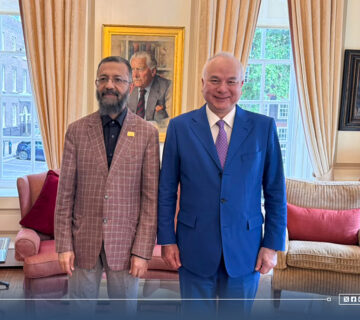
During the opening ceremony, and as an expression of appreciation, H.E. Mr. Yousef Hassan Khalawi and H.E. Ambassador Hossam Zaki honored H.E. Dr. Hala El Said with the shield of the late Sheikh Saleh Kamel, founder of AlBaraka Forum.
Their excellencies also honored AlBaraka Bank Egypt, the platinum sponsor of the Fifth AlBaraka Forum Regional Conference, represented by Dr. Hassanein Abdel Moneim, Head of Shariah Supervision and Shariah Audit Sector at the Bank, who received the shield of the late Sheikh Saleh Kamel.
The conference also witnessed AlBaraka Forum’s launch of its new report in, as part of AlBaraka Economic Reports series, titled “Personal Remittances in the OIC Countries (2017–2024)”, which highlights the growing role of remittances as one of the most stable and impactful financial flows in supporting household livelihoods and economic growth.
First Panel Session
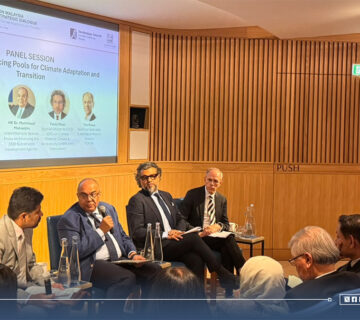
Financing Development Amid the Global Debt Crisis: The Role of Ethical and Sustainable Finance Instruments
The first panel session was chaired by H.E. Prof. Dr. Mahmoud Mohieldin, United Nations Special Envoy on Financing for Sustainable Development, who stressed that the debt crisis is no longer merely a financial issue, but a comprehensive development crisis affecting countries’ ability to finance public investment and essential services, amid overlapping global crises that have narrowed fiscal space and increased development costs, alongside declining external aid and rising debt servicing burdens.
His excellency noted that reliance on unstable sources to finance infrastructure reveals the fragility of the current model and its need for comprehensive restructuring, emphasizing that Islamic finance offers a different model linked to the real economy and provides effective tools for financing sustainable development and addressing debt crises, based on achieving benefit and objectives rather than financing for its own sake.
During the session, H.E. Dr. Ali Mohsen Ismail Al-Alaq, Governor of the Central Bank of Iraq, focused on the increasing pressures facing monetary policy due to the rising demand for foreign currency, particularly the US dollar, and the resulting challenges in maintaining exchange rate stability and citizens’ purchasing power, amid heavy reliance on imports and the dominance of oil revenues over public finances.
His excellency explained that the limited flexibility of public spending, tied to wages, subsidies, and essential services, constrains the government’s ability to adapt to fluctuations in oil prices, warning of the risks of inflationary financing. He stressed that the central bank should not be a permanent solution for financing fiscal deficits and underscored the importance of diversifying revenue sources, strengthening the productive base, and highlighting the pivotal role of Islamic finance as an ethical and developmental model linking finance to the real economy.
H.E. Dr. Mohamed Farid Saleh, Chairman of the Financial Regulatory Authority, highlighted the decisive role of legislative and regulatory frameworks in activating sustainable and Islamic finance instruments, explaining that the development of regulatory rules has contributed to the launch of successful issuances of sukuk and sustainability bonds. These instruments have enabled the financing of projects that were previously unable to access funding through traditional tools, thereby supporting the real economy and creating job opportunities.
His excellency also pointed to the role of financial technology and crowdfunding in expanding the investor base, affirming that the role of financial regulation lies in achieving financial stability and protecting investors’ rights, which enhances confidence in modern financing instruments.
Second Panel Session
Islamic Instruments for Sustainable Development: From Green Sukuk to Waqf and Zakat
The session was moderated by Dr. Walid Hegazy, Founder and Managing Partner, Hegazy & Partners, who emphasized that Islamic economic thought has, since its inception, provided clear ethical foundations for economic and social development. However, the practical application of the Islamic financial industry over recent decades has drifted away from these foundations in favor of integration into the conventional financial system. He noted that the global return to sustainability concepts represents an opportunity to revive these authentic principles.
Dr. Younes Soualhi, Member of the Shariah Committee, Bursa Malaysia, and Islamic finance expert, affirmed that digital financial inclusion represents a strategic pathway for Islamic finance, provided that it extends to achieving the objectives of Shariah and maintaining a strong link to the real economy. He stressed the need to address challenges related to trust, regulatory frameworks, and the limited range of digital products.
Dr. Hassanein Abdel Moneim, Head of Shariah Supervision and Shariah Audit Sector, AlBaraka Bank Egypt, reviewed the key challenges facing Shariah governance in Islamic financial institutions, foremost among them the absence of unified standards and the multiplicity of fatwas, emphasizing the importance of enhancing transparency and unifying regulatory frameworks to support the sustainability of the industry.
Mr. Mohamed Adly El-Qeie, Head of Islamic Corporate Credit and Investment, Banque Misr, stated that global transformations have made green finance and sustainable trade an inevitable necessity, explaining that environmental impact has become a direct factor in credit decisions, and that Islamic finance represents a supportive framework for sustainable development.
Third Panel Session
Financial Innovation and Emerging Technologies: New Horizons for Enhancing the Role of the Islamic Economy in Global Development
The session was moderated by Dr. Wassim El-Metwally, Head of Strategic Planning Sector, AlBaraka Bank Egypt, who emphasized that financial innovation and emerging technologies have become critical elements in developing the Islamic economy, whose global size is approaching USD 4 trillion. He reviewed successful international experiences in digital sukuk and zakat, alongside the efforts of the Central Bank of Egypt in supporting financial technology and financial inclusion.
Dr. Marwa Mohamed Emad Saleh, Director General of Economic Issues Department, Information and Decision Support Center affiliated with the Prime Minister, confirmed that financial technology is a pivotal tool for achieving financial inclusion, stressing the importance of legislative and regulatory policies in guiding this development, and noting the progress achieved by Egypt in digital infrastructure.
Prof. Dr. Hussein Abdou, Professor of Finance and Banking – Newcastle Business School, Northumbria University, explained that rapid digital transformation is imposing a new reality on the banking sector and the labor market, emphasizing the need for integration among governments, banks, and educational institutions to prepare future talents.
Dr. Ahmed Shawky Soliman, Banking Expert and Member of the Advisory Board of the Egypt Center for Economic and Strategic Studies, confirmed that Shariah-compliant digital financing platforms have contributed to accelerating case assessments, improving the quality of credit decisions, and supporting partnership and mudaraba models, thereby enhancing financing efficiency and its broader outreach.
The Fifth AlBaraka Forum Regional Conference concluded by affirming that Islamic finance, through its ethical and sustainable instruments, represents a realistic pathway to supporting comprehensive development, addressing debt crises, and building a more just and sustainable economy.