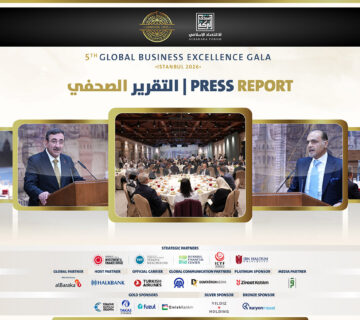

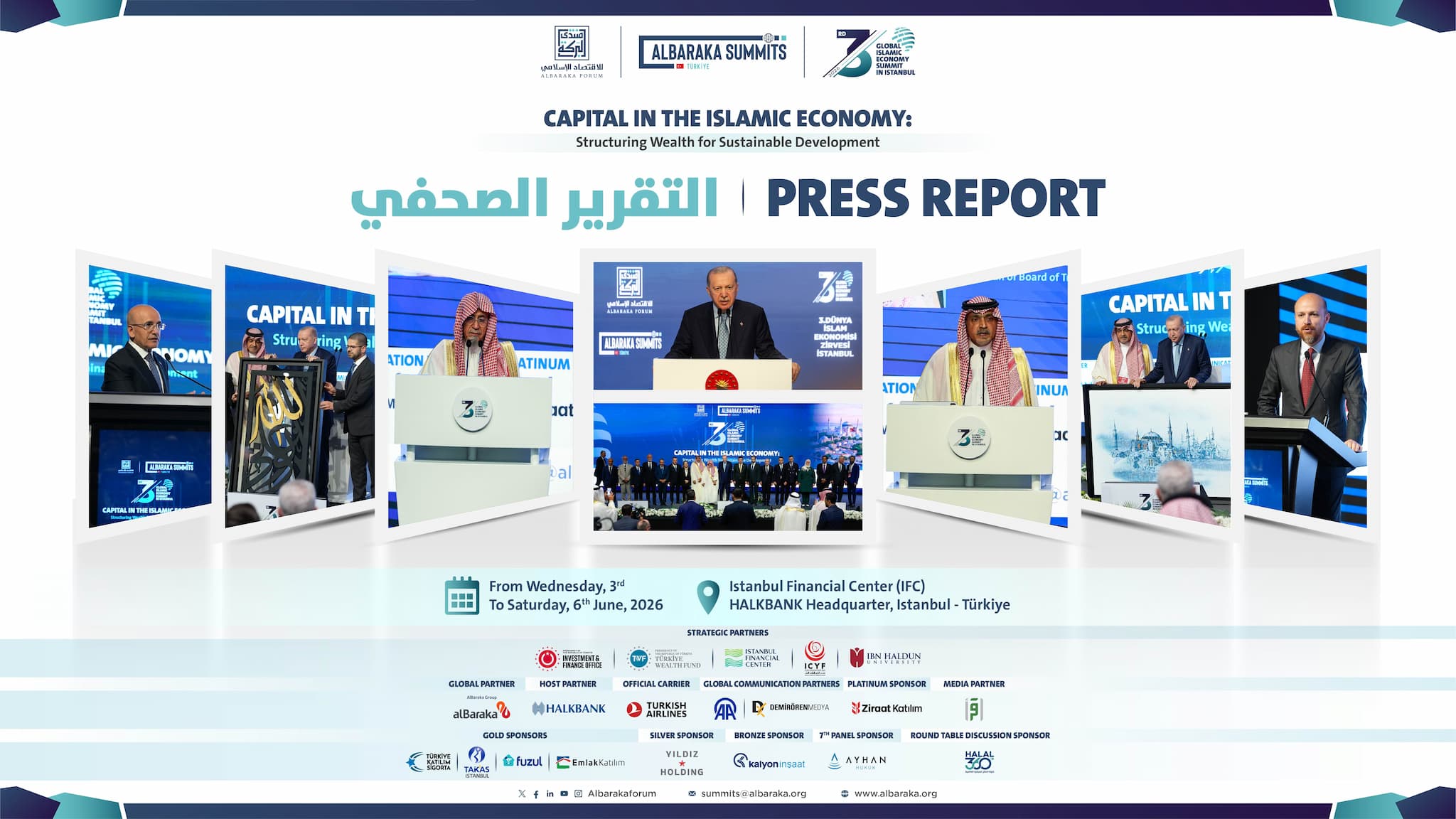
From Wednesday to Saturday, June 3rd to June 6th, the 3rd Global Islamic Economy Summit in Istanbul, organized by AlBaraka Forum for Islamic Economy as part of AlBaraka Summits series, commenced at the Istanbul Financial Center under the theme “Capital in the Islamic Economy: Structuring Wealth for Sustainable Development”, honored by the gracious presence of the President of the Republic of Türkiye, H.E. Recep Tayyip Erdoğan.
Held at the headquarters of the host partner Halkbank, the summit was held in strategic partnership with The Presidency of the Republic of Türkiye Investment and Finance Office, Türkiye Wealth Fund (TWF), Istanbul Financial Center (IFC), Islamic Cooperation Youth Forum (ICYF) and Ibn Haldun University.
Official Opening Ceremony — Friday, June 5th, 2026
The official opening ceremony of the 3rd Global Islamic Economy Summit began with the recitation of selected verses from Surah Al-Hadid, recited by Sheikh Mohamed Salem Amer, Qur’an Reciter and Imam at Al-Azhar Mosque.
H.E. Mr. Abdullah Saleh Kamel, Chairman of Board of Trustee, AlBaraka Forum for Islamic Economy, delivered a keynote address in which his excellency emphasized that economies grounded in ethics and the pursuit of public benefit are more capable of continuity and resilience in the face of crises, presenting “Muslim Capital” as a living and highly relevant concept, rather than merely a traditional proposition, calling for an economic model that balances the individual and society, freedom and responsibility, ambition and compassion.
H.E. Sheikh Dr. Saleh bin Abdullah bin Humaid, Advisor at the Royal Court of Saudi Arabia, Member of the Council of Senior Scholars, and Imam of Al-Masjid Al-Haram, highlighted the need for Islamic financial institutions to move beyond merely receiving fatwas on the rulings of emerging products, toward a broader developmental function rooted in Maqasid, emphasizing that Islamic banks should not simply act as financing institutions, but as partners in economic and social development.
A film titled “WHAT CAPITAL BUILDS” was premiered during the ceremony, highlighting the role of Islamic finance in connecting capital to real economic activity, productive investment, Sukuk, waqf, participation finance, and sustainable development across global markets.
H.E. Recep Tayyip Erdoğan, President of the Republic of Türkiye, delivered the presidential note in emphasizing the need for a new economic and financial paradigm centered on justice, ethics, production, and equitable distribution, warning that financial crises will remain unavoidable unless the structural deficiencies of the current system are addressed.
H.E. The President also underscored that the pursuit of a fairer world reflects humanity’s ability to develop viable alternatives to the existing global financial architecture, calling for stronger efforts to challenge the current system while implementing practical and concrete alternatives.
Day 2 — Thursday, June 4th, 2026
With warm and inspiring words, Ms. Efnan Han, TRT World Presenter and Master of Ceremonies, welcomed participants to the second day of the 3rd Global Islamic Economy Summit in Istanbul, setting the stage for discussions on the true purpose of capital as a tool for confidence-building, opportunity creation, and sustainable investment.
The day began with the recitation of selected verses from Surah Al-Baqarah, recited by Dr. Mohamed Kourid, Lecturer, Regional Academy of Education and Training – Marrakech-Safi Region.
H.E. Mr. Ahmet Burak Dağlıoğlu, President, Investment and Finance Office of the Presidency of the Republic of Türkiye, highlighted the Office’s focus on four key pillars: internationalization, strategy development, ecosystem development centered around the Istanbul Financial Center, and infrastructure and capacity building.
H.E. Mr. Salim Arda Ermut, Chief Executive Officer and Member of the Board, Türkiye Wealth Fund, emphasized that capital should not be assessed solely by short-term returns, but by the value it creates for society. He highlighted Islamic finance as a framework that supports productive activity, encourages responsibility, and connects capital with long-term value creation.
H.E. Prof. Dr. Imad AbuKishek, President of Al-Quds University, presented the Al-Quds University Education Development Waqf Model, highlighting how charitable contributions and endowments can be transformed into sustainable investments that continuously support education, research, innovation, and community development.
H.E. Mr. Iqbal Ahmad Khan, Chief Executive Officer of Fajr Capital, delivered a keynote address titled “Capital as Amanah: A Global Islamic Economic Vision,” focusing on the responsibility of capital, ethical investment, and the role of Islamic economic principles in shaping a more balanced global financial system.
H.E. Mr. Mehmet Şimşek, Minister of Treasury and Finance of the Republic of Türkiye, delivered a keynote address titled “Capital, Development, and Inclusive Prosperity”, emphasizing the need to reconnect capital with productive development priorities, noting that Islamic finance is closely linked to the real economy through asset-backed transactions, also highlighting Türkiye’s ambition to become one of the world’s top five countries in Islamic financial assets, while presenting new investment incentives designed to attract capital, talent, entrepreneurs, and foreign direct investment.
In his strategic opening remarks, H.E. Mr. Necmeddin Bilal Erdoğan, Deputy Chairman of the Board of Trustees at Ibn Haldun University, emphasized that Islamic finance should not be measured by numbers alone, but by the values and principles that distinguish it.
Following the screening of the official launch video of the first AlBaraka Strategic Report on Islamic Economy, which showcased the report’s overall vision, key themes, and methodology, H.E. Mr. Yousef Hassan Khalawi, Secretary General of AlBaraka Forum for Islamic Economy, delivered welcoming remarks in which he announced the Forum’s second challenge: developing a reporting system for the Islamic economy. He highlighted the lack of reliable data in key areas such as zakat and waqf, emphasizing the importance of building stronger measurement frameworks for the sector.
The report, which is published every five years, aims to move beyond fragmented sectoral analysis by presenting a comprehensive framework that connects Islamic financial institutions, the halal industries, Islamic social finance, the economics of religious institutions and rituals, and the macroeconomic realities of OIC countries.
The summit witnessed the signing of four Memoranda of Understanding:
- The General Council for Islamic Banks and Financial Institutions, represented by Hamza K. Bawazir, Secretary General of the Council, signed an MoU with the Organization of Islamic Cooperation Arbitration Centre, represented by Dr. Umar Oseni, Secretary General of the Centre.
- Saleh Kamel Islamic Economics Award, represented by E. Mr. Yousef Hassan Khalawi, Secretary General, AlBaraka Forum for Islamic Economy, signed an MoU with Istanbul Sabahattin Zaim University, represented by its Rector, H.E. Prof. Dr. İsmail Küçük.
- AlBaraka Forum for Islamic Economy, represented byE. Mr. Yousef Hassan Khalawi, Secretary General, AlBaraka Forum, signed an MoU with the Union of Broadcasting and Television Organizations of the Organization of Islamic Cooperation, represented by H.E. Prof. Dr. Amr Mamdouh Ellissy, President of (OSBU).
- Ibn Haldun University, represented by Dr. Atilla Arkan, President of Ibn Haldun University, signed an MoU with the Securities Commission Malaysia, represented by Dato’ Mohammad Faiz Azmi, Executive Chairman, Securities Commission Malaysia.
As an expression of thanks and appreciation, the partners and sponsors of the 3rd Global Islamic Economy Summit in Istanbul were honored in the presence of H.E. Mr. Necmeddin Bilal Erdoğan, H.E. Mr. Mehmet Şimşek, H.E. Mr. Ahmet Burak Dağlıoğlu, H.E. Mr. Salim Arda Ermut, and H.E. Mr. Ahmet İhsan Erdem, Chief Executive Officer, Istanbul Financial Center.
- Global Partner: Al Baraka Group represented by Mohamed Ebrahim Alshroogi, Vice Chairman of Al Baraka Group
- Host Partner: HalkBank represented by Recep Süleyman Özdil, General Manager and Board Member, HalkBank
- Global Communication Partner: Anadolu Ajansı represented by Oğuz Enis PERU, Anadolu Ajansı Vice President & COO
- Global Communication Partner: Demirören Media Group represented by Meltem Demirören, Deputy Chairman of Demirören Holding
- Platinum Sponsor: Ziraat Participation Bank represented by Suat Tüccar, Deputy General Manager of Ziraat Katılım
- Gold Sponsor: Türkiye Katılım Sigorta represented by Dr. Servet Bayındır, Chairman of the Board, Türkiye Katılım Sigorta
- Gold Sponsor: Takasbank represented by Mahmut Kayacik, Chairperson, takasbank
- Gold Sponsor: Fuzul represented by Eyüp Akbal, Chairman of the Board, Fuzel
- Gold Sponsor: Türkiye Emlaak Katılım
- Silver Sponsor: Yıldız Holding represented by MUHARREM UZUNOĞLU, Yıldız Holding Financial Affairs Vice President
- Bronze Sponsor: Kalyon İnşaat represented by Mr. Murathan Kalyoncu, Chairman of the Board of Kalyon İnşaat
- 7th Panel Sponsor: Ayhan Hukuk represented by Namık Ayhan, Lawyer and Founder of Ayhan Hukuk Bürosu
- Round Table Discussion Sponsor: Halal 360 represented by Mahmood Godel, Chief Executive Officer, Halal 360
- Media Partner: Iqraa Channel represented by Hassan Omar A Alattas, Manager of Iqraa Channel
Dr. Umar Oseni, Secretary General of the OIC Arbitration Centre, moderated the first panel, “Foundations of Capital in the Islamic Economy: Concept, Principles, and Purpose.” The session explored the role of Islamic banking groups in capital circulation, cross-border investment, regional financial integration, ethical capital, and future wealth creation in emerging economies.
Mr. Malek Khodr Temsah, General Manager and Board Member of Albaraka Türk Participation Bank, highlighted the responsibility of Islamic banks beyond financing, focusing on financial inclusion, ethical capital deployment, cross-border trade, fair banking, and support for underserved communities.
Mr. Khurram Hilal, Chief Executive Officer, Group Islamic Banking at Standard Chartered Bank, addressed the need for leadership in the Muslim world amid geopolitical and macroeconomic shifts, emphasizing the role of Islamic finance in promoting resilience, responsibility, and long-term value.
Mr. Rafe Haneef, Group Chief Executive Officer of MBSB Holding that, comprises MBSB Bank and MIDF group, discussed the responsibility attached to capital in Islamic finance, highlighting the need to deploy capital responsibly and sustainably while balancing Maqasid-oriented impact with investor expectations.
Prof. Dr. Mehmet Bulut, Board Member, The Scientific and Technological Research Council of Türkiye, moderated the second panel on combating trade challenges and enhancing economic integration through digital Islamic banking and Takaful. The session addressed OIC economic and financial integration in the digital age, with a focus on digitalization, artificial intelligence, and emerging financial approaches.
Mr. Hamza K. Bawazir Secretary General, General Council for Islamic Banks and Financial Institutions (CIBAFI), highlighted trade as one of the strongest tools for economic development across OIC countries. He emphasized the natural link between Islamic finance, trade, and the real economy, while calling for stronger standards, coordination, talent development, and institutional commitment.
Dr. Ekrem Arıkan, Chief Executive Officer, Central Securities Depository and Trade Repository of Türkiye, discussed Türkiye’s central securities infrastructure and its role in supporting capital markets, agricultural products, crowdfunding platforms, and data services, emphasizing transparency, dynamic reporting, and strong financial infrastructure.
Dr. Tarık Akın, Head of Finance Department, Investment and Finance Office of the Presidency of Türkiye, presented the Integrated Digital Islamic Trade Facilitation Framework as a project aimed at addressing OIC trade challenges, reducing cost and access barriers, and supporting SMEs through Islamic finance and fintech solutions.
Mr. Nitish Bhojnagarwala, Associate Managing Director, Moody’s Ratings, moderated the third panel on capital formation and intermediation across banks, funds, and Islamic capital markets. He outlined the four pillars of Islamic finance: Islamic banking, Sukuk, Takaful, and funds, while noting the growth potential of Türkiye and Indonesia in expanding global Islamic finance penetration.
Dr. Usman Chaudry, Chief Risk Officer, Gatehouse Bank plc, shared Gatehouse Bank’s experience in Sharia-compliant capital formation, highlighting how the bank links retail savers with the real economy through home finance, real assets, ownership structures, and institutional capital partnerships.
Dr. Mahmut Kayacık, Chief Financial Officer and Chief Operating Officer, Türkiye Wealth Fund, highlighted the Fund’s role across Islamic banking, Sukuk, Takaful, and Islamic funds. He emphasized participation finance as a strategic model that channels capital into the real economy, supporting manufacturing, employment, sustainable development, and efficient capital allocation.
Prof. Mehmet Asutay, Professor of Middle Eastern and Islamic Political Economy and Finance, Director, Durham Centre for Islamic Economics and Finance, delivered an address titled “Capital in Islamic Economic Theory: Value Creation, Exchange, and Development.” He emphasized that capital should be assessed according to how it is acquired, used, shared, and governed, with justice, stewardship, Maqasid, and access to resources at its core.
Datuk Mohd Irwan Mohd Mubarak, Chairman, Bank Kerjasama Rakyat Malaysia Berhad, moderated the fourth panel on Waqf as the Islamic legacy of sustainable capital. The session explored the transition from short-term capital optimization to long-term, purpose-driven capital deployment through Waqf, sadaqah jariyah, and sustainable social impact.
Dr. Khalid bin Abdulrahman Al-Rajhi, Member of the Council, Waqf Sulaiman AlRajhi, discussed cash Waqf as a contemporary form of Islamic endowment, highlighting how investment vehicles and regulatory frameworks can expand participation, strengthen sustainable impact, and connect philanthropic giving with economic and social development.
Dr. Ayman Bekiroğlu, Assistant Professor, Faculty of Management Sciences, Department of Economics, Ibn Haldun University, discussed the historical development and modern potential of cash Waqf. He emphasized the importance of preserving the core purpose of Waqf while exploring modern vehicles such as capital market instruments, corporate share endowments, and digital tokenization to enhance transparency, security, management, and social development.
Day 3 — Friday, June 5th, 2026
Dato’ Mohammad Faiz Azmi, Executive Chairman of the Securities Commission Malaysia, delivered a keynote address titled “Empowering Islamic Investment: The Securities Commission Malaysia’s Five-Year Strategy Towards 2030.” He outlined the Commission’s vision for building a vibrant, inclusive, and sustainable capital market, while positioning Malaysia as a gateway to regional opportunities and Islamic investment growth.
In a thought-provoking session moderated by H.E. Prof. Dr. Mahmoud Mohieldin, United Nations Special Envoy on Financing the 2030 Sustainable Development Agenda, discussions focused on re-engineering capital flows to better connect macroeconomic policy with real economic development. H.E. Mohieldin emphasized that finance must be directed toward meaningful outcomes, including SMEs, households, infrastructure, trade, food security, and job creation, while also highlighting the need to move beyond GDP as the sole measure of progress toward broader indicators of inclusion, sustainability, governance, and institutional strength.
H.E. Dr. Fatih Karahan, Governor of the Central Bank of the Republic of Türkiye, highlighted the distinction between wealth and capital, emphasizing that wealth becomes capital only when mobilized into productive use. He stressed the role of price stability, financial stability, and effective financial intermediation in transforming savings into real economic activity, while noting the potential of participation finance in broadening inclusion and supporting SMEs and productive sectors.
H.E. Mr. Abdul Rasheed Ghaffour, Governor of Bank Negara Malaysia, emphasized that the global challenge lies not in the shortage of capital, but in its misallocation. Drawing on Malaysia’s experience, he highlighted the role of Islamic finance in directing capital toward productive investment, sustainability, halal value chains, regional integration, SMEs, and inclusive development through tools such as risk-sharing, asset-backed financing, blended finance, Zakat, and Waqf.
H.E. Mr. Yahya Jawdat Hafez Shunnar, Governor of the Palestine Monetary Authority, addressed the importance of ensuring that capital flows serve the real economy, particularly in contexts where SMEs, agriculture, infrastructure, and employment remain underfinanced. He presented Islamic finance as a framework for resilience, inclusion, and ethical growth, drawing on Palestine’s experience in digital payments and SME-focused funds under challenging conditions.
H.E. Mr. Ahmet İhsan Erdem, Chief Executive Officer of Istanbul Financial Center, delivered a keynote address titled “Türkiye’s Participation Finance Ecosystem and Capital Mobilization: The Role of Financial Centers in Attracting Capital.” He highlighted Istanbul Financial Center’s role in combining advanced physical infrastructure with a supportive regulatory framework, positioning Türkiye as a strategic hub connecting regional and global capital flows
Following, the summit proceeded to the official opening ceremony, marking a key moment in the 3rd Global Islamic Economy Summit in Istanbul.
Day 4 — Saturday, June 6th, 2026
Moderating the fifth panel on sectoral allocation of capital, Mr. Asad Ansari, Co-Founder, Amanah Islamic Finance, highlighted the vital role of SMEs in driving economic growth, employment, and empowerment within the real economy. He raised key questions on how Islamic finance can help attract capital, encourage entrepreneurship, and develop financing structures that serve small businesses, infrastructure needs, and broader economic development in line with Maqasid Al-Shari’ah.
Ms. Sharifatul Hanizah Said Ali, Executive Director, Islamic Capital Market, Securities Commission Malaysia, reflected on Malaysia’s four-decade journey in Islamic finance, highlighting how sukuk evolved from a Shari’ah-compliant alternative into a mainstream tool for mobilizing long-term capital. She emphasized Malaysia’s strong Shari’ah governance, regulatory framework, and innovative sukuk structures in supporting infrastructure, strategic sectors, and socioeconomic development.
Mr. Firman Nugraha, Director of Treasury & International Banking at Bank Syariah Indonesia, highlighted Indonesia’s MSME-driven growth story and the role of Islamic finance in expanding productive capacity through regulatory support, inclusive instruments, and MSME empowerment.
Mr. Mohamed Hegazy, Chief Executive Officer and Managing Director of ADI Taskeek, ADIB, discussed the role of Islamic banks in advancing sustainability, climate resilience, ESG integration, and responsible resource efficiency through Shari’ah-compliant finance.
Moderating the sixth panel on digital capital and financial innovation, Mr. Nizam Uddin OBE, Senior Advisor, New World Group, highlighted the momentum of Islamic FinTech and digital assets, including tokenized sukuk, on-chain settlement, and AI-driven compliance. He emphasized the need to ensure that technology, governance, and Shari’ah integrity move together to support the sector’s future growth.
Mr. Murat Onuk, Managing Partner, Arz Portföy, discussed the future architecture of Islamic digital finance, noting that the sector is moving from simple digitization toward deeper market infrastructure transformation. He highlighted the role of AI screening, smart contracts, digital identity, and tokenization in enhancing transparency, trust, liquidity, and cross-border access.
Eng. Khalid Howladar, Managing Partner, Acreditus, highlighted the opportunity for Türkiye to become a center for the new Islamic digital asset economy. He emphasized the potential of a Türkiye-first digital asset architecture built on Sharia-compliant instruments, tokenized sukuk, regulated access, reserve-backed digital assets, and blockchain-based settlement infrastructure.
Moderating the seventh panel on capital formation strategies for young business leaders, Dr. Wael Eldesouki, Secretary General of SKSEED, highlighted the importance of helping startups and young entrepreneurs access the right capital to launch, grow, and scale sustainably. He emphasized the need for smarter financing solutions, stronger institutional support, and better links between young businesses and capital providers.
Dr. Mohamad Darwish, Head of Business Solutions, Emirates Islamic, discussed the importance of starting with the right capital structure at the early stage. He highlighted the role of Islamic finance, equity-based funding, impact investing, governance, due diligence, and institutional support in helping entrepreneurs build sustainable businesses.
Dr. Ayman ElTarabishy, President of the International Council for Small Business and Professor at The George Washington University, addressed SME growth and impact, emphasizing that successful entrepreneurship requires mentorship, access to resources, seed funding, ecosystem support, clear value propositions, and the ability to turn innovation into sustainable businesses.
Moderating the leadership talk on Islamic finance in the eyes of the media, Ms. Farzana Baduel, Chief Executive Officer, Curzon PR, highlighted the importance of inclusive communication in making Islamic finance more accessible to wider audiences. She emphasized the need for clearer messaging, stronger storytelling, and consistent terminology to build trust and understanding.
Dr. Gökhan Yücel, Head of Department, Communications, Finance and Investment Office, The Presidency of the Republic of Türkiye, highlighted the need to bridge the gap between perception and reality in Islamic finance through stronger communication, clearer narratives, and more effective global engagement.
Moderating the influencer session, Ms. Sidra Iqbal, Senior Broadcast Journalist, highlighted the shift from the attention economy to a trust economy, where creators are valued by authenticity, meaningful engagement, and long-term audience confidence.
The session featured Mr. Ahmed Talaat, Founder and Host of “Btaa’ Eqtisad” and Economic Content Creator, who emphasized that true influence is measured by audience engagement and meaningful impact rather than follower count alone. Ms. Saira Hayati, Public Influencer, discussed the importance of balancing visibility with privacy while maintaining authenticity and responsible engagement. Dr. Mohamed Talal Lahlou, Chief Executive Officer, PC Consulting, highlighted the importance of staying true to one’s convictions and building long-term trust through meaningful content.
During Ethis’ institutional experience on Islamic digital investment tools for SME financing, Mr. Umar Munshi, Co-Founder and Managing Director, Ethis, highlighted how technology can address SMEs’ access-to-finance challenges. He discussed the potential of AI, Web3, smart contracts, and micro-sukuk platforms in advancing participation finance and supporting inclusive SME growth.
Day 1 — Wednesday, June 3rd, 2026
Mr. Junaid Wahedna, Founder of Wahed, and Ms. Amy, Head of Accounts at Wahed Malaysia, led an institutional workshop titled “Capital Formation in the Digital Era: Tangibility and Realities.”
The workshop explored how technology can empower middle-income earners to create, manage, and distribute capital more effectively through accessible, Shariah-compliant financial solutions. Discussions focused on financial inclusion, asset ownership, avoiding debt traps, digital wealth management, and innovative models such as real estate crowdfunding and digital waqf.
Prof. Dr. Hasan Vergil, Head of the Department of Economics, School of Business, Ibn Haldun University, discussed savings-based financing in Türkiye and its role within the Islamic economy. He highlighted the sector’s rapid growth, operational models, and policy challenges, emphasizing that customer outcomes depend not only on contract design, but also on inflation dynamics, monetary policy, transparency, and effective regulatory guidance.
Dr. Hesham Zaki, Executive Secretary of the Saleh Kamel Islamic Economics Award, moderated the interactive academic session “From Research to Impact,” held under the patronage of SKIEA. The session provided postgraduate students with a platform to present their research in Islamic economics and finance before leading academics and experts, while emphasizing the importance of constructive scholarly feedback and strengthening the link between academic research and practical impact.
The session featured research presentations by Anwar Adem from Sakarya University (ISEFAM), who examined the drivers of Takaful adoption in Ethiopia; Dr. Souhaila Guedira from Istanbul Sabahattin Zaim University, who explored the integration of waqf with policy strategies for public goods provision, drawing lessons from the Ottoman Empire for modern Türkiye; Vasfi Akdeniz from Istanbul University, who proposed a Shariah-compliant blockchain-based payment alternative for international trade finance; Salim Saidy from Ibn Haldun University, who discussed the role of Islamic FinTech in translating institutional strength into inclusive outcomes; and Namra Muhammad from Ibn Haldun University, who examined the impact of financial inclusion on income inequality across developing countries.
Dr. Iman Shady, Executive Secretary, Strategic Thinking Center, led the workshop “The Economic Landscape of Muslims: Realities and Transformations”. The workshop explored human resources across OIC countries and Muslim minorities, highlighting their role in productivity, sustainable development, innovation, and consumption. It also discussed key challenges and strategic opportunities for Islamic economic institutions to invest in human capital and strengthen Muslim communities.
Parallel Sessions
The roundtable discussion, “Islamic Economics and Halal in Central Asia: Current Realities and the Way Forward,” brought together experts and regional at the Summit in Istanbul to explore institutional readiness, Islamic capital mobilization, halal sector opportunities, and the design of a distinct Central Asian model for Islamic economics.
H.E. Mr. Yousef Hassan Khalawi, Secretary General of AlBaraka Forum for Islamic Economy, emphasized that Central Asia represents an important emerging market with strong potential to join and contribute to the Islamic economy industry.
At the Industry Strategic Dialogue, “The Strategic Role of Banking Associations and Federations in the Advancement of Islamic Banking Industry,” Mr. Hamza K. Bawazir, Secretary General, General Council for Islamic Banks and Financial Institutions (CIBAFI), highlighted the need for stronger collaboration between international organizations, national associations, regulators, and industry stakeholders.
He emphasized that the dialogue marks the beginning of a continued initiative to strengthen advocacy, coordination, and representation for the global Islamic banking industry.
Closing Remarks
In his closing remarks, H.E. Mr. Yousef Hassan Khalawi, Secretary General, AlBaraka Forum for Islamic Economy, emphasized investment as a defining distinction between Islamic and conventional banking. He highlighted that Islamic banking is not built on loans, but on investment and financing models that reflect the true essence of the Islamic economy, noting that investment will be the Forum’s focus for the coming year.